Week 4
Constructing Experiment 1
For my first experiment, I wanted to start with something broad because I’m still not
completely sure about my direction. I’ve been a little worried that my ideas might not
have enough of a design element yet or that I’m not sure how to translate my concepts
visually.
So, I decided to work off the mind map we made in class. Most of my notes and
stickers ended up in the category of being overly reliant on AI, which gave me a good
starting point. Because AI is something that needs active engagement, I wanted to think
og something that had to do with interaction.
I first thought about making a little storybook, but I wasn’t confident in the idea since it would only be based on my own perceptions for now. Then I considered an instruction manual, similar to IKEA assembly guides. Each page could have a title like “How to use AI to write your emails” or “How to use AI to write an apology to a friend.” As the pages progress, the scenarios would become more personal, eventually showing how AI is taking over someone’s life. I thought it was a fun concept, but again, it was based only on my own perspective, and I really wanted to collect information from other people.
Another idea came up after talking to Janessa. She suggested comparing how people write about their own day versus how AI would interpret or rewrite it. I liked this idea because it involved collecting real input from participants. However, I realised it might end up being more about human versus computer interpretation rather than over-reliance. Still, I decided to build on this line of thought and refine it.
Final Idea
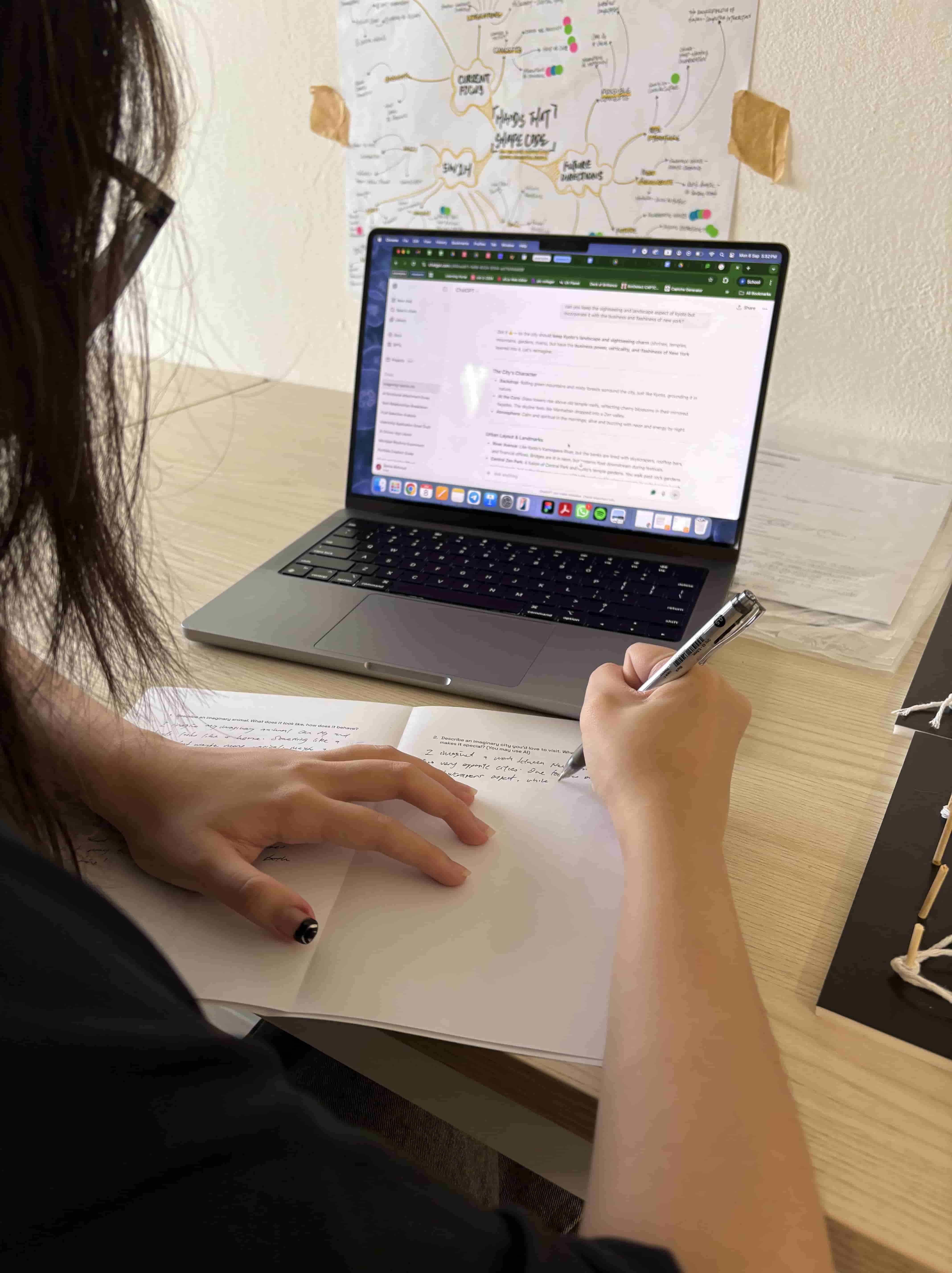
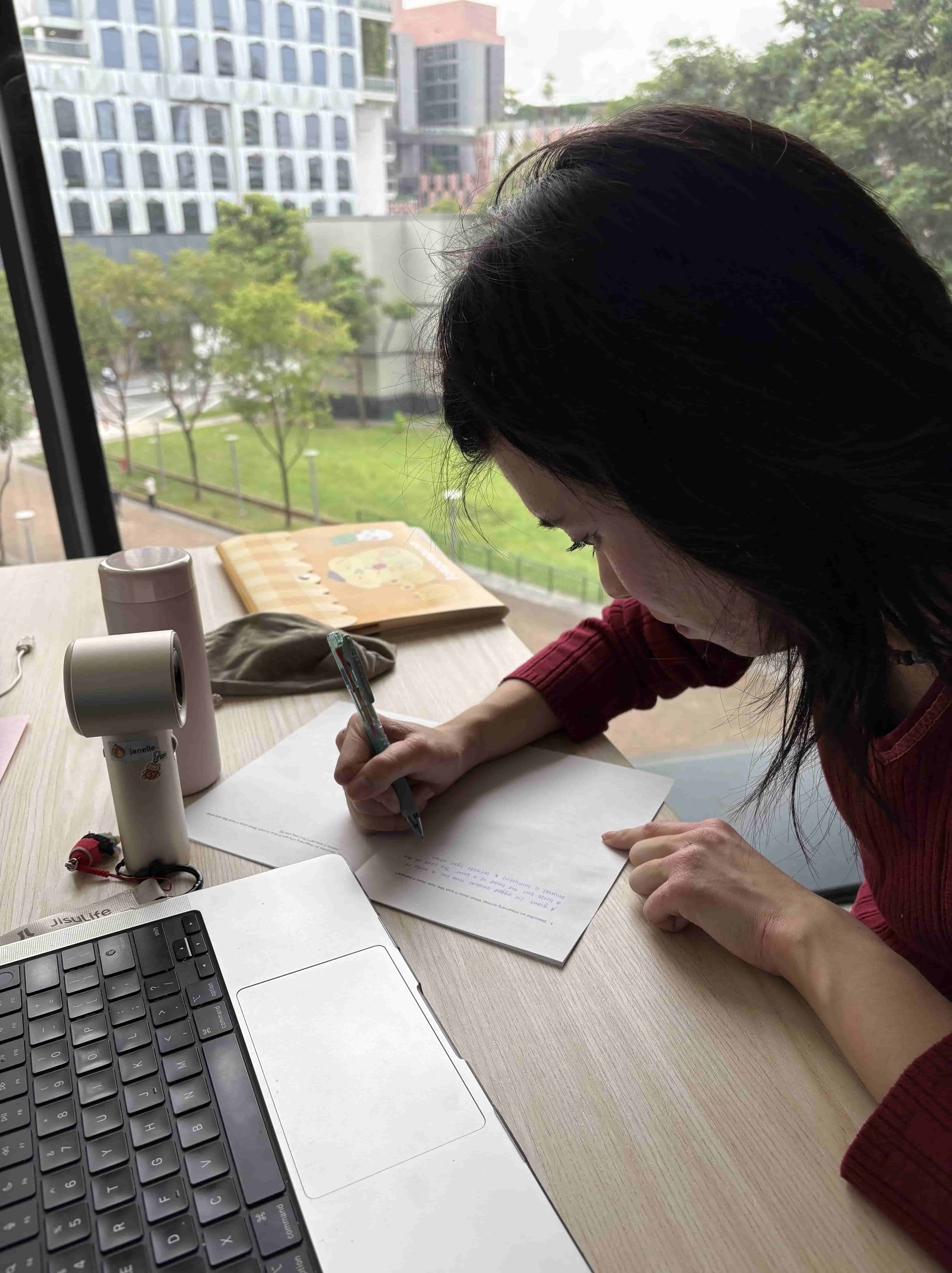
Creative Writing Task
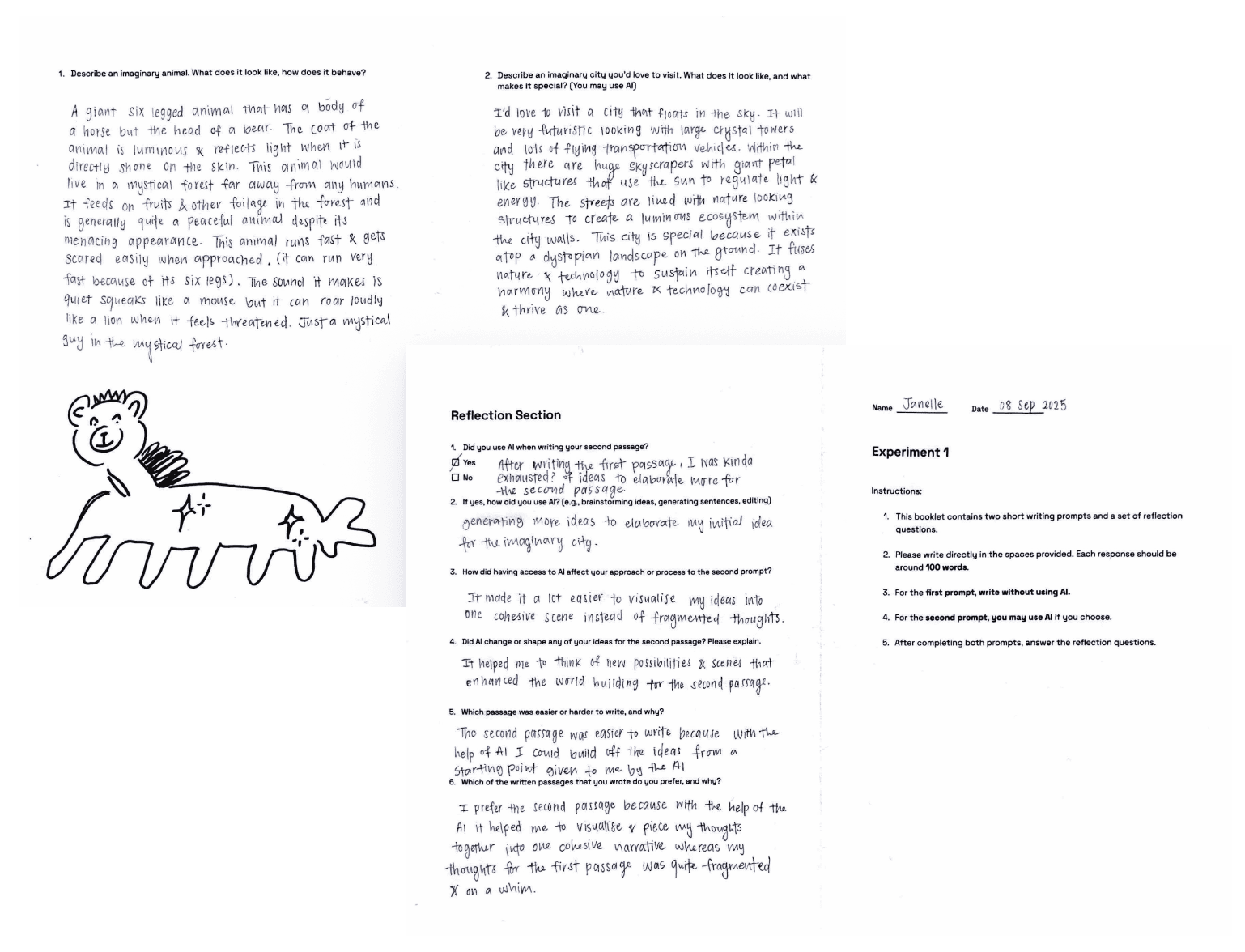
I decided to run a creative writing task with two questions. For the first question,
participants had to rely entirely on their own creativity and were not allowed to
use AI. For the second question, they were given the option to use AI if they
wanted. After completing both writing tasks, everyone filled out a short reflection
form.
The goal with this experiment was to observe how easily is it for people to fallback
on AI when given the option. I was curious to see if they would choose to use it for
convenience, inspiration, or any other reason. Additionally, I wanted to understand
how they felt about their own creativity in comparison to AI-generated content.
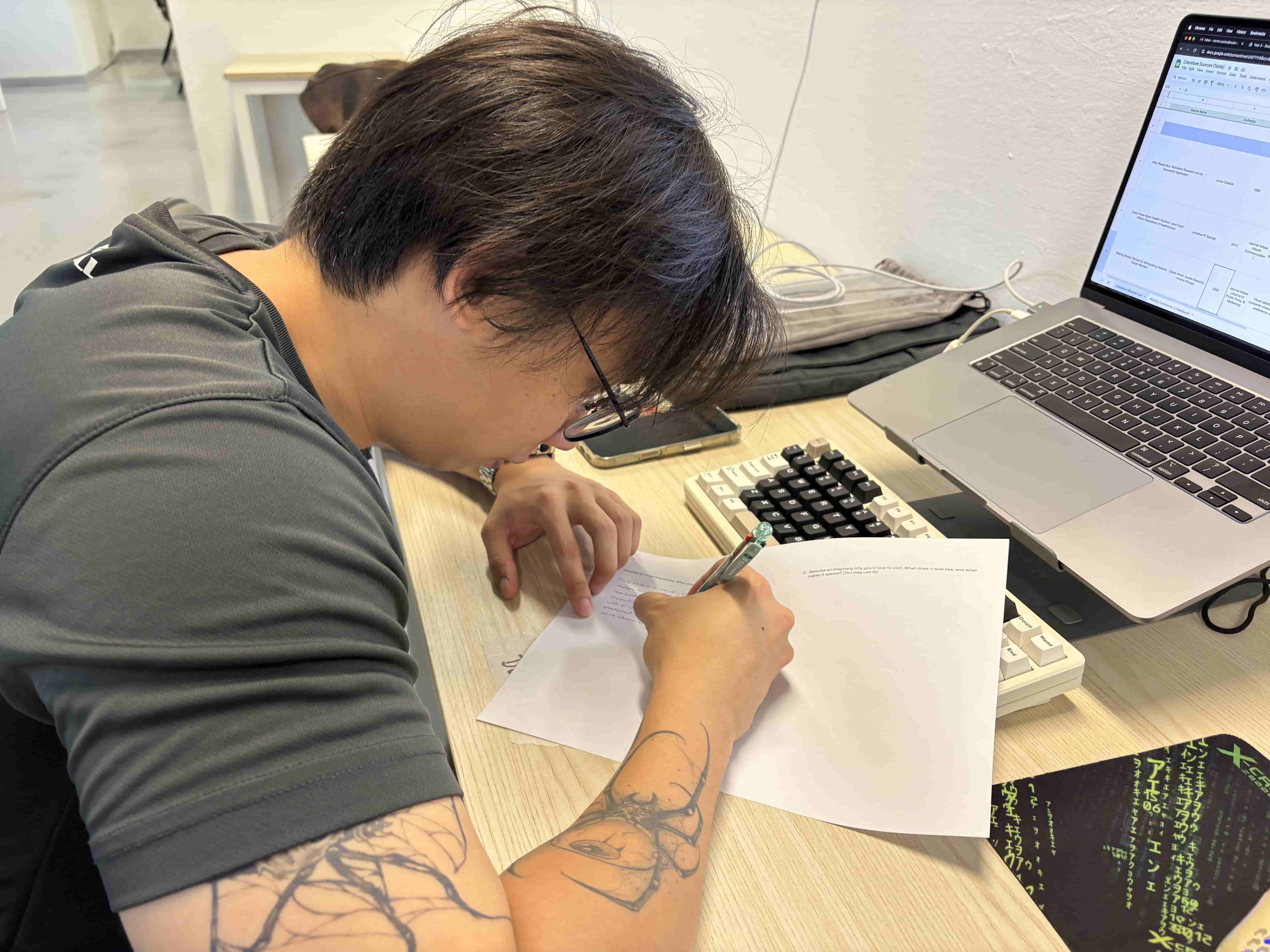
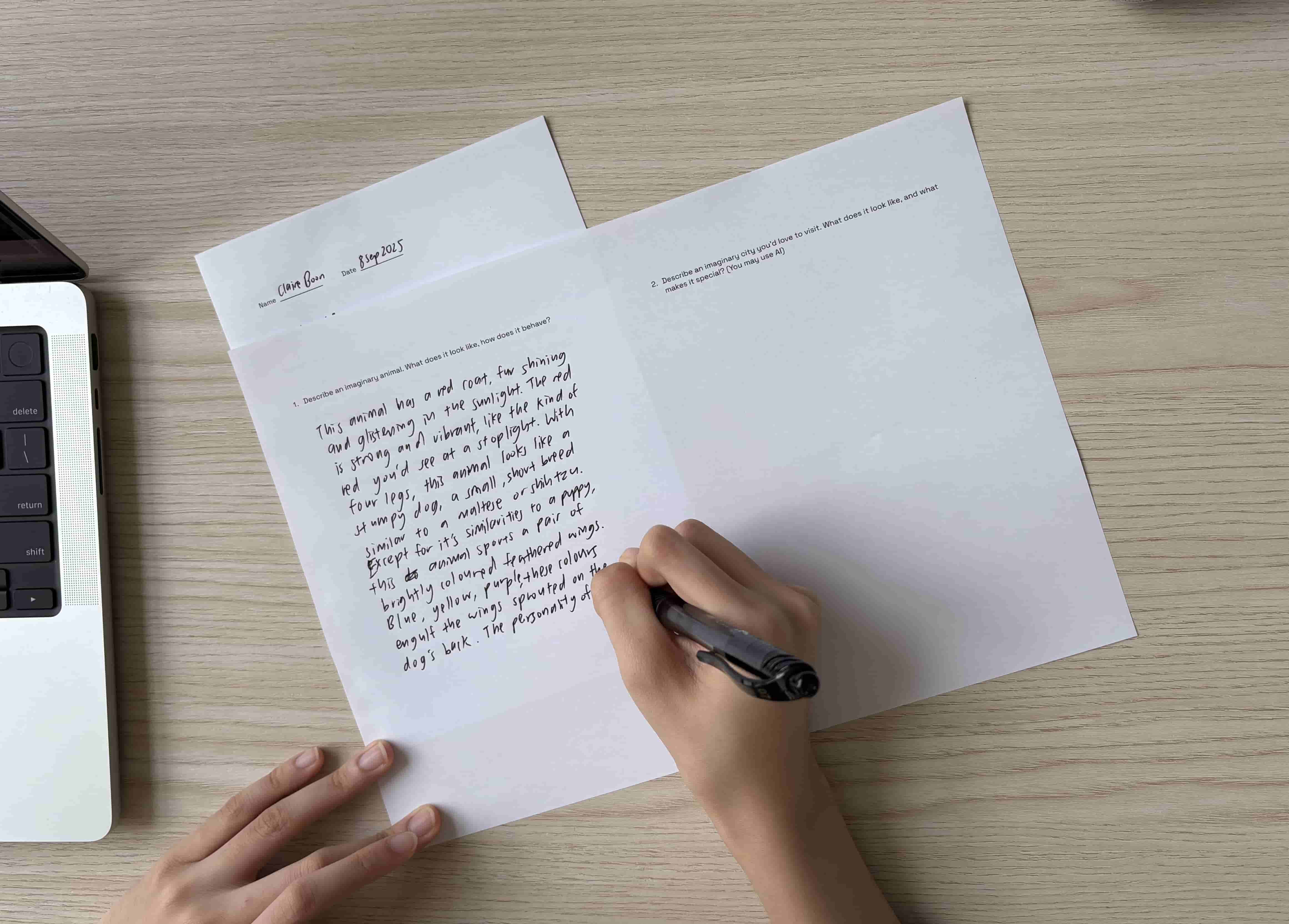
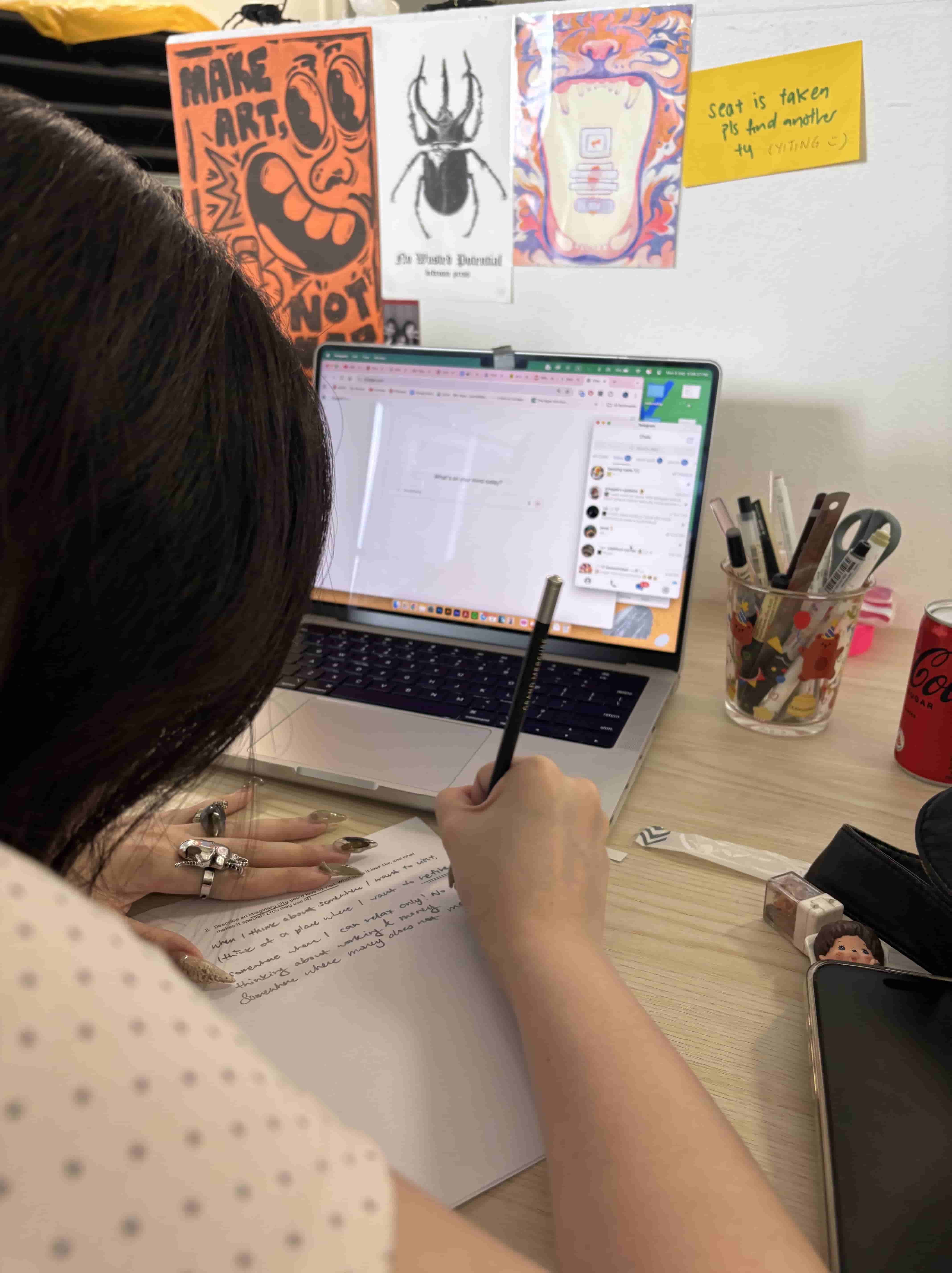
Mid-experiment
What did I learn?
I managed to get eight participants for this experiment. Out of the eight, only two people chose not to use AI for the second question. The rest did. Of those who used AI, four said it was easier to let AI do the thinking for them, while two used it to generate images to help them visualise their ideas before writing. I also noticed that some people copied AI’s responses almost directly, while others only took inspiration or rephrased parts.
Interestingly, even those who only took ideas from AI ended up writing pieces with similar imagery, like crystals and waterfalls, and even similar sentence structures, especially in their conclusions. This experiment made me realise how quickly AI can limit creativity and critical thinking. Many people naturally let AI take over inconvenient tasks, which highlights how easy it is to become dependent on it.
Consultation Feedback
During this week’s consultation, we discussed using the book as a material and
finding design references that naturally connect to the theories I’m engaging with.
The key is to build a link between theory and design so it doesn’t feel forced. We
also talked about thinking critically about the boundary between my own thinking and
the machine’s thinking, and how AI models often share similar characteristics.
Andreas explained that I should think about my methods as my toolbox, and the
techniques I use, like prototyping or interviews, are to help me explore ideas. We
talked about how experiments can go wrong, and that’s fine because the point is to
get comfortable with the techniques I want to use. Over time, the techniques will
get stronger.
He also reminded me that talking doesn’t always have to mean a literal conversation.
It can come through physical sensations, motion, etc. We can think about AI in both
dystopian and utopian ways. For example, chatbots can be seen as the first step
towards more evolved forms of AI companionship.
He asked me if I’m curious about
designing chatbots with personality and what an ideal companion might look like.
He suggested that my introduction could be built around my research question, as
that would make it easier to develop both the RPO and dissertation later. The
critical journal will also be helpful in framing my project because it connects
making and thinking. Once I figure out my objective and anchor, everything else
becomes more manageable.
At this point, I also have drafted my first couple of pillars:
1. Technology shaping identity
How we form connections with technology and AI, and how that affects the way we think. Core reading: Life on the Screen by Sherry Turkle, which looks at how computers shape our sense of self and lay the groundwork for intimacy with machines.
2. Over-reliance and self-agency
Who is really in control when we use AI? Core reading: Psychopolitics: Neoliberalism and New Technologies of Power by Byung-Chul Han.
2. Over-reliance and self-agency
Who is really in control when we use AI? Core reading: Psychopolitics: Neoliberalism and New Technologies of Power by Byung-Chul Han.
Finally, Andreas recommended that I watch a video by Elliot Montgomery about discursive design, which turned out to be really interesting. The video explained that discursive design isn’t about finding solutions but about revealing new sides to a problem. It challenges social rules and opens space for debate. Montgomery described design as a form of discussion it doesn’t need to fix anything, but can help people rethink their relationships with the world around them.I found this especially relevant to my topic because the question of whether AI is good or bad for society doesn’t have a simple answer. It’s not something that can be solved, but it’s something worth reflecting on and talking about. So, I think discursive design could play an important role in my project moving forward.